
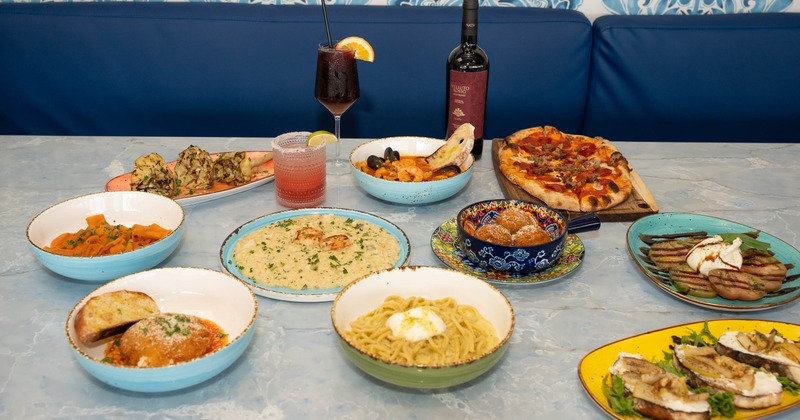
What to order at a Sicilian restaurant depends on whether you want the dishes Sicily is known for or the ones that are simply good, and those lists overlap less than you would think. Amuri Italian Cuisine is a Sicilian restaurant in Rancho Peñasquitos run by a family from Bagheria, and this is the order we would put in for a first-timer sitting at one of our tables tonight.
Start with Arancini
Arancini are fried rice balls, usually filled with ragu and peas or with mozzarella, rolled in breadcrumb and fried to order. The name means little oranges, which is what they look like when they come out.
They matter because they are proof of the island’s history. Rice and saffron arrived in Sicily under Arab rule, the same cultural layering UNESCO recognized when it listed Arab-Norman Palermo as a World Heritage site. No northern Italian kitchen invents a fried rice ball. Order them first, because they take a few minutes and they arrive hot.
Cioppino, and the Honest Story Behind It
Here is the thing about cioppino: it is not from Sicily. It is from San Francisco. Italian fishermen, mostly Genoese, worked Meiggs’ Wharf in the late 1800s and made a tomato-based fish stew out of whatever the boats brought back, adapting the Ligurian dialect dish ciuppin — a word that, as food historian Erica Peters told KQED, simply refers to making soup from fish. The first printed recipe showed up in a 1906 cookbook sold to raise money after the earthquake.
So it is an Italian-American dish with a California birth certificate. We serve it anyway, and we serve it well, because the technique is Sicilian even if the name is not: shellfish cooked in tomato, garlic, white wine and chili, with mussels, clams, shrimp and calamari. If you want cioppino in San Diego and you want it made by people who cook seafood for a living, this is a fair place to get it.
The Pasta to Order
Simone rolls pasta every morning. Tonnarelli is the shape to pay attention to — square-cut, rough-surfaced, and it holds cacio e pepe in a way dried spaghetti simply cannot.
The pistachio pasta is the other one. Bronte pistachio, ground into a sauce and finished with burrata. Bronte is a protected origin product: Pistacchio Verde di Bronte has held Protected Designation of Origin status since 2010 and grows only in the lava soil on Etna’s western slopes, harvested every other year. Between the two dishes you get the whole argument for why Sicilian food is different from Italian food.
The Cheese Wheel Is Not a Gimmick
Pasta finished tableside inside a hollowed Pecorino wheel gets eye-rolls from people who have seen it done badly. Done badly, it is a photo op. Done properly, the residual heat of the pasta melts the interior wall of the wheel and the cheese coats the strands in a way a saucepan cannot reproduce.
The test is simple: if the pasta is dried and the wheel is a prop, skip it. If the pasta was rolled that morning, order it. Ours was.
What to Skip on the First Visit
Chicken parmigiana. It is on the menu, we make a good one, and half the tables in the room order it. But it is an Italian-American dish you can get anywhere in the county, and ordering it on your first visit means leaving without having eaten anything Sicilian.
Same for the pizza, which is genuinely good and genuinely beside the point until visit two. Bring the kids, order it for them, and eat something else yourself.
Reserve a table for a weeknight if you want the kitchen unhurried.
Cannoli, and Why Timing Matters
A cannolo is a fried shell filled with sweetened ricotta. The only rule that matters is that it must be filled when you order it, not in the morning. A shell that has been sitting filled for six hours is soft, and a soft cannolo is a wasted cannolo.
Traditional Sicilian ricotta is sheep’s milk, which is tangier and less sweet than the cow’s milk version most American bakeries use. Ours is finished with pistachio at the ends. If you are looking for cannoli in San Diego, ask one question before ordering anywhere: are they filled to order? The answer tells you everything about the kitchen.
What to Drink, and What It Costs
Sicilian wine is the underrated part of the list. Nero d’Avola is the island’s main red — dark, plummy, low acid, and it handles tomato sauce better than Chianti does. Frappato is lighter and worth it with seafood. Etna Rosso comes off volcanic soil and drinks closer to Burgundy than anyone expects at the price. Grillo is the white to order with the cioppino.
A full first-timer order — arancini, one pasta, one seafood dish, two glasses of wine and a cannolo — runs about ninety to a hundred dollars for two before tip. The happy hour from 2 to 5 p.m., Monday through Thursday is cheaper if you just want to try a few things.
Frequently Asked Questions
What should a first-timer order at a Sicilian restaurant?
Arancini to start, one handmade pasta, one seafood dish to share, and a cannolo. That covers the Arab influence, the pasta work and the coastline in a single sitting.
Is cioppino actually Sicilian?
No. It was created by Italian immigrant fishermen in San Francisco in the late 1800s. Sicily has its own seafood stews, but cioppino as a named dish is Italian-American.
Do I need a reservation?
Weeknights, usually not. Friday and Saturday after 6 p.m., book two or three days ahead. Groups of eight or more should use the private dining room, which seats about twenty.
Where is Amuri, and what are the hours?
9932 Mercy Rd, Unit 109, San Diego, CA 92129, in the Canyon Hills Shopping Center. Open every day from 11 a.m. to 9 p.m. It is the building Pernicano’s occupied for 48 years.
Ready to Get Started?
Bring this list with you or ignore it entirely and ask the server what came in fresh. Either way, order the arancini first.
Get in touch or call us at (858) 397-2199.